Code-Mixing
The blending of vocabulary and grammatical structures from multiple languages, known as code-mixing, is a natural developmental phase for multilingual children. This pattern persists into adulthood, with polyglots demonstrating a learned ability to regulate their code-switching depending on context.
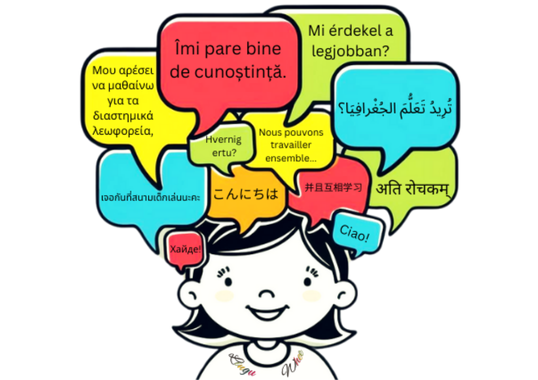
Image text
Japanese: こんにちは (Hello!)
Icelandic: Hvernig ertu? (How are you?)
Romanian: Îmi pare bine de cunoștință. (Glad to meet you.)
Hungarian: Mi érdekel a legjobban? (What interests you most?)
Arabic: تُرِيدُ تَعَلُّمَ الجُغْرافِيَا؟ (Do you want to learn about geography?)
Sanskrit: अति रोचकम् (That's very interesting.)
Greek: Μου αρέσει να μαθαίνω για τα διαστημικά λεωφορεία. (I like to learn about space shuttles.)
French: Nous pouvons travailler ensemble. (We can work together.)
Chinese: 并且互相学习 (And learn from each other.)
Thai: เจอกันที่สนามเด็กเล่นนะคะ (See you on the playground.)
Bulgarian: Хайде! (Let's go!)
Italian: Ciao! (Bye!/Hello!)
Code-mixing is common in our multilingual family, with our kids
producing the most inventive (and funny) cross-language expressions.
It's important to remember that although early code-mixing in children can
occur because they may only know certain vocabulary in specific languages,
it is not a sign of confusion. Similarly, code-mixing later in life
(once a solid vocabulary and grammar base has been acquired) is a sign of
linguistic creativity, not a lack of ability. Multilinguals develop the ability
to adjust their language use based on the context, topic, and audience,
and can certainly speak in only one language when the situation calls for it
(e.g., in more formal settings or when speaking with monolingual family members).